
Finding Colton Residents
Colton has no single current residents directory that names every person in the city. The useful trail is split by the question being asked. The San Bernardino County Assessor connects a parcel to an assessment record, while the Recorder-Clerk indexes parties to recorded instruments. City permits can add an applicant, contractor, or project date. A court docket can confirm that a person appears in a public case, but it is not a complete biography. California voter data is purpose-limited, and a self-lookup is different from a third-party search. Older occupants appear in printed directories, telephone books, census schedules, newspapers, and family-history collections.
Begin with the strongest fact already in hand. An address should become an APN, or assessor parcel number, before deed research starts. A name should be tested against a second anchor such as an age range, spouse, former address, occupation, or business role. An old household should be dated before any modern record is treated as a match. The result is a set of sourced clues, not a claim that one roll proves who lives at a property today.
- Normalize the address with the county parcel map and separate the situs address from any tax mailing address.
- Use the APN, legal description, or a carefully matched name to find the county assessment record.
- Search the Recorder-Clerk index by grantor or grantee, document type, number, or recording range.
- Use California My Voter Status only for the person making the identity-gated lookup, not as a street roster.
- For an older resident, pair a directory, census, newspaper, or probate clue with the correct year and custodian.
Colton's Three Records Desks
Colton is an incorporated city in San Bernardino County, but it is not the county seat. That distinction matters. City Hall keeps municipal permits, planning material, maps, and public-record request files. The San Bernardino County Assessor-Recorder-Clerk, often called ARC, keeps the assessment roll, recorded instruments, and county vital copies. San Bernardino Superior Court handles trial-court case information for Colton. Each office can answer a narrow record question, but no office is a substitute for the others.
The address and phone details below are useful starting points. ARC lists separate Assessor Services and Recorder-Clerk Services numbers. The City Clerk's form accepts requests to inspect records or receive copies. Hours can differ by counter, and the city's pages publish more than one general schedule, so verify before an in-person visit.
San Bernardino County ARC
Hall of Records
222 W. Hospitality Lane
San Bernardino, CA 92415
Recorder-Clerk 909-387-8306
ARC Assessor Services
Hall of Records
222 W. Hospitality Lane
San Bernardino, CA 92415
Assessor Services 909-387-8307
Colton City Clerk
City Hall
650 N. La Cadena Drive
Colton, CA 92324
909-370-5001
Start with Colton eTRAKiT
For a current address, Colton's eTRAKiT portal is the municipal starting point for Building, Fire, Planning, and Public Works material. An anonymous visitor may conduct a general property search. A registered owner or builder account opens more detail and actions, while contractors use a state license number and an initial passcode based on the phone record. The portal can connect an address to applications, plans or studies, inspections, final sign-off, continuing-compliance material, and related business-license registration.
A permit record is not a residents directory. It is valuable because it supplies time and role clues. An applicant, owner-builder, contractor, or inspection event can help distinguish two people with the same name. It can also show when an addition or repair was documented. Use the Colton eTRAKiT instructions for the live search modules and account rules, since labels may change as the city's 2026 enhancements roll out.
| eTRAKiT field or mode | What it contributes |
|---|---|
| Property search | Address-led entry point for a general public search |
| Permit or project number | Direct retrieval when a number is already known |
| Contractor or AEC account | Account path tied to a state license number |
| Plans, inspections, payments | Project chronology and public transaction context |
Keep the permit date beside the name. A later inspection cannot prove that the applicant lived at the address, and a missing permit record cannot prove that no work occurred.
Colton Parcel Search Fields
The county's Assessor Property Information page leads to Parcel Access and a public map. It is the best first bridge from a street address to a durable parcel identity. Search by APN, use the address geocoder, or pan and click a parcel polygon. The map can show adjacent parcels. A situs address identifies where land sits; a tax mailing address identifies where assessment mail goes. Those are not the same claim.
| Field | Type | Required | What to record |
|---|---|---|---|
| APN | Text | No | Primary parcel identifier; format varies by book, page, and parcel |
| Street address | Text or geocoder | No | Situs location used to find the parcel on the map |
| Map location | Interactive map | No | Polygon, location, and nearby parcel context |
| Layers and basemap | Map controls | No | Jurisdiction and context layers available at use time |
A representative parcel card may show APN, situs, an owner or assessee when legally displayable, tax mailing address, legal description, assessed land and improvement values, exemptions, tax-rate area, and property characteristics. The county does not advertise a special owner-name query service. Record the APN and legal description before moving to the Recorder-Clerk index.
- Parcel
- A mapped unit of land identified by the assessor, often through an APN.
- Situs address
- The physical location of the parcel, not necessarily the address where tax mail is sent.
- Index
- A catalog entry that points to a record; it is not the full instrument or certified copy.
- Assessment roll
- The assessor's valuation and property record, not a roster of every occupant.
Mailing Address Is a Lead
The tax mailing address can be useful when a parcel's owner receives notices somewhere else. It may point to an owner, estate, trust, or business contact outside Colton. It cannot establish that the named person lives at the situs. The same caution applies to an exemption, a permit applicant, or a deed party. Each is evidence of a role in a record, not a complete statement about a household.
For street-level work, the Colton street directory by address uses the parcel as the spine and keeps owner, mail recipient, permit participant, and listed occupant in separate columns. That separation prevents a current property record from being mistaken for a current resident record. It also makes a later correction easier because the wrong fact can be sent to the correct custodian.
| Claim | Strongest local source | What it does not prove |
|---|---|---|
| Where land is located | Assessor situs and parcel map | Who occupies the structure |
| Where tax mail goes | Assessor mailing field | Owner residence or presence |
| Who signed an instrument | Recorder index and deed image | Current ownership without the full chain |
| Who applied for work | eTRAKiT permit file | Residence at the time of application |
The Colton Deed Index
San Bernardino County's Official Public Records Index reaches from 1925 to the present. It indexes document number, document date, title, grantors, and grantees. Grantor means a party conveying an interest; grantee means a party receiving one. Search every spelling variation, and remember that the index is a catalog guide rather than the legal instrument. The county warns that its products do not make a legal-title determination.
The web index is free, but document images are not displayed remotely. The reason is tied to Government Code section 6254.21. Contents can be inspected at the Hall of Records or High Desert Government Center in Hesperia, or requested as a copy. The county states $4 for the first page and $1.50 for each later page. Online card orders carry a 3.5 percent surcharge. Mail charges announced for July 1, 2026 are $3.50 standard or $29 priority.
The ARC official-records instructions explain the index, office route, and copy process. A non-certified online order can be emailed, while a certified order ships. Mail turnaround is stated as one to two weeks, and appointments are strongly encouraged. Maps are sold only at the Hall of Records.
The San Bernardino recorder index is most useful after the APN, legal description, or a likely party name is known. Search the current grantee, capture the document number and date, then inspect the instrument before treating the result as a link in a title chain.
The San Bernardino Superior Court case-information portal is the source shown in the image and a separate record path from the deed index.
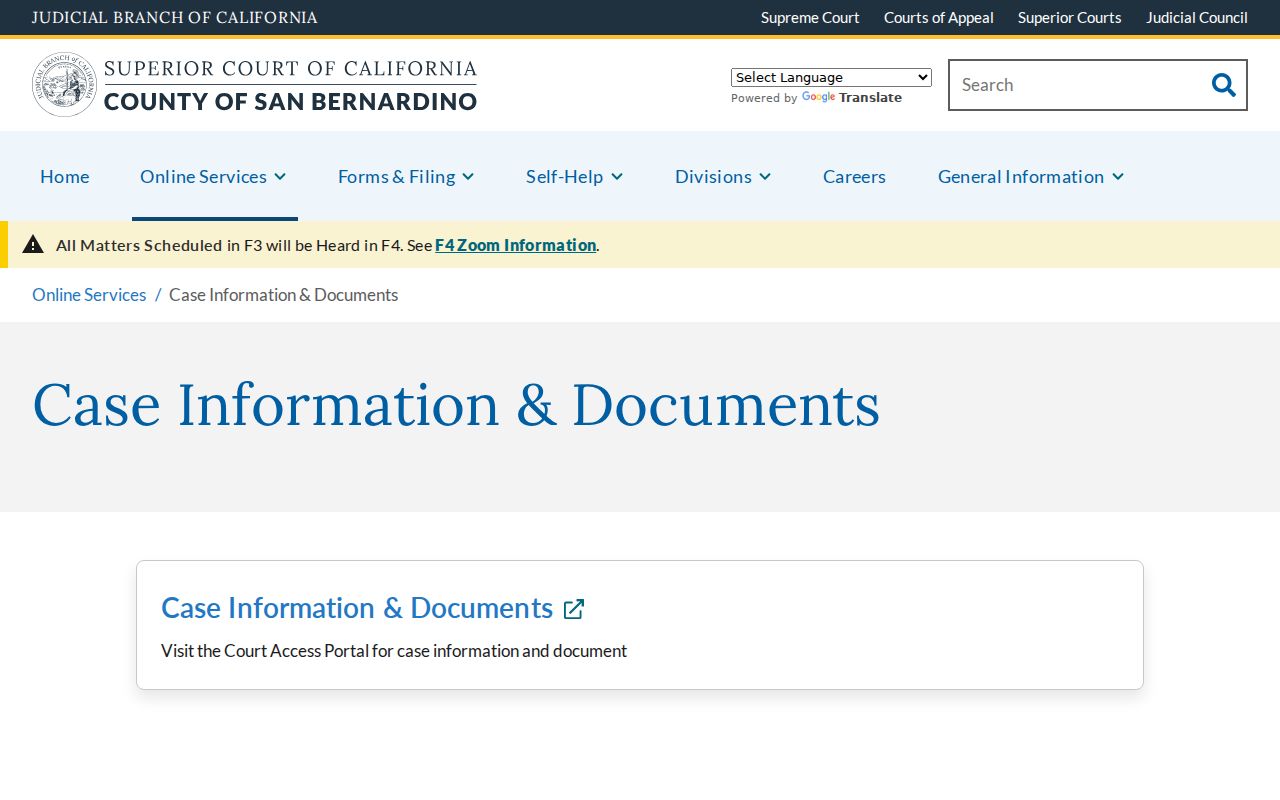
The image is a reminder that a person search may cross record systems. A court result can supply a case role or date, but it should not be treated as proof of residence or as a complete history.
Current Colton Residents Directory Sources
Modern records resemble a directory only when their limits stay visible. The county property roll is parcel-centered. The recorder index is instrument-centered. The City Clerk's staff directory is a public contact list, not a list of residents. The city library catalog points to materials rather than publishing a current household roll. Neighborhood groups named in city planning material are contacts and community layers, not public membership rosters.
| Source | It can show | Keeper | Access boundary |
|---|---|---|---|
| Parcel Access | APN, situs, assessment facts, mailing contact | County Assessor | Free map and parcel search |
| Recorder index | Parties, document title, number, and date | County ARC | Free index; image by office or order |
| eTRAKiT | Permit applicants, projects, inspections | Colton Development Services | General search; account for detail |
| My Voter Status | The requester's own registration status | California Secretary of State | Identity-gated self-lookup |
| City staff directory | Department contacts and public employees | City of Colton | Free web directory |
The useful sequence is address to APN, APN to parcel facts, parcel facts to recorded parties, and then an independent record for identity. California My Voter Status is for a person checking their own registration. The state does not turn it into an ordinary browse-by-street residents directory.
California Voter File Limits
California's voter system has two separate doors. My Voter Status requires first name, last name, date of birth, and an identity check such as the last four digits of a driver license or ID or, when applicable, the last four of a Social Security number. It can return the matched voter's registration status, party preference, districts, polling information, vote-by-mail status, and voting history where available. Voting history means that a ballot was recorded, not how anyone voted.
Voter-file release is controlled by Elections Code section 2194 and 2 CCR sections 19001 to 19013. Election, scholarly, journalistic, political, or governmental purposes can qualify through the proper request channel. Street home address, phone, email, registration and precinct numbers, prior registration, identity numbers, and signatures are confidential under Government Code section 7924.000. Safe at Home participants and other confidential classes are excluded.
A statewide request is listed at $100. A qualified request for up to ten identified voters is $30 per record, capped at $100, and requires full name, date of birth, county, residence address, purpose, and security commitments. A California voter file is not an open Colton street directory. The Secretary of State request rules explain who may apply and what use is allowed.
The California My Voter Status lookup is the source shown here and asks for identity details before returning a person's own status.
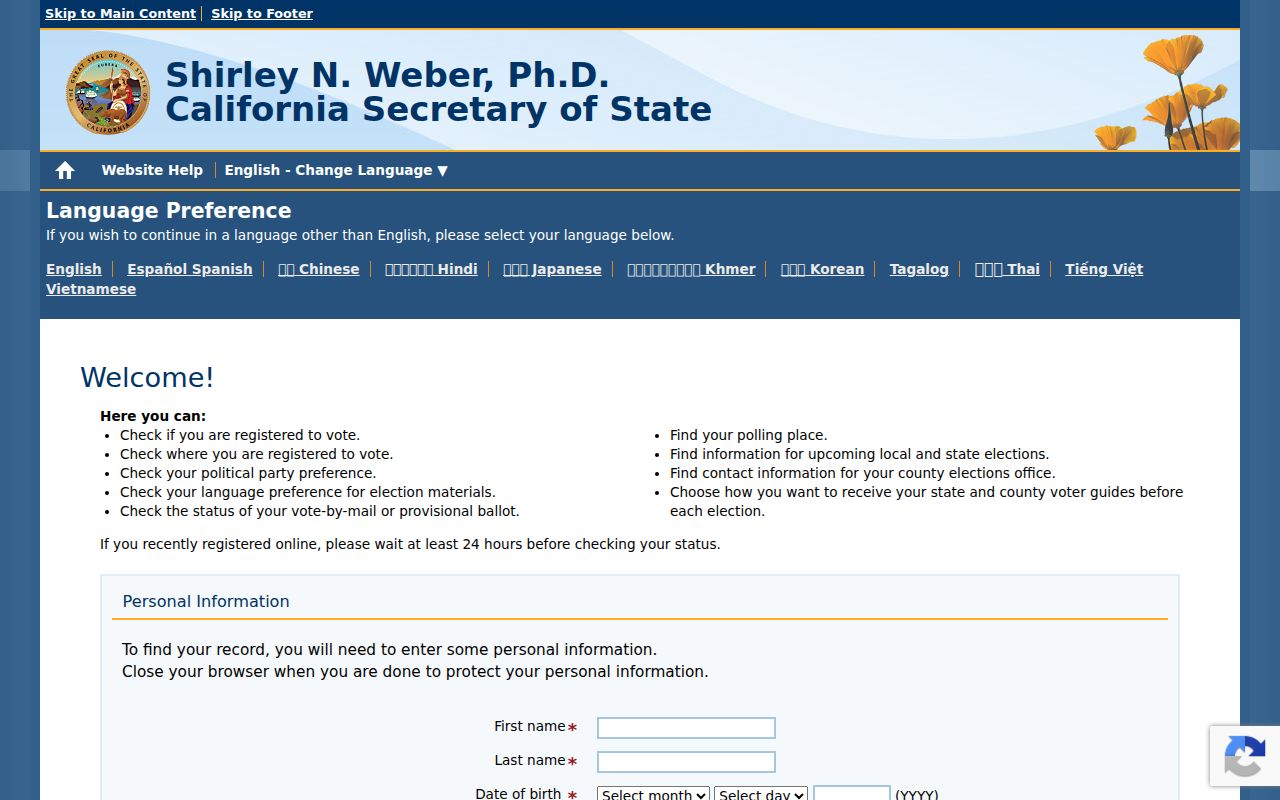
It is therefore a verification tool, not a source for publishing names by block. For historical residents, the Great Registers at the California Room offer a different, dated source.
Court Names Need Context
San Bernardino Superior Court serves Colton for civil, criminal, family, probate, small-claims, and traffic case information, subject to case and document limits. The Court Access Portal can search by case number, party or business name, date of birth when needed for disambiguation, case type, and filing-date range. A result may show case number, filing date, location, status, party roles, register-of-actions events, hearing dates, dispositions, and a document list.
Remote access is narrower than courthouse access. California Rule of Court 2.503 can keep a public document off the remote screen while a courthouse terminal makes it available. Juvenile, adoption, sealed, confidential, and protected victim material remains restricted. Probate petitions can help locate heirs because they may name relatives and addresses, but an allegation in a filing is not an adjudicated fact.
- Docket
- The court's chronological case record, often called the register of actions.
- Disposition
- The recorded outcome or status of a matter, which must be read in case context.
- Certified copy
- A copy issued with the custodian's certification, subject to the court's current fee rules.
Federal cases use PACER and the U.S. District Court for the Central District of California, not the county portal. Federal access can charge by page, with a per-document cap and quarterly waiver rules described by PACER. A court-name hit is one clue in a Colton residents directory search, never a complete criminal-history report.
Colton Vital Copy Choices
California separates informational certified copies from authorized certified copies. An informational copy can confirm that a record exists but is marked not valid for identity. An authorized copy is limited to listed people and roles under Health and Safety Code sections 103525 and 103526. Mailed authorized-copy requests require the applicable sworn statement and notarization. Confidential marriage copies are handled under Family Code section 509 and are restricted to spouses or a court order.
| Record | Colton custodian | Access distinction | 2026 CDPH fee |
|---|---|---|---|
| Birth | County recorder, local registrar, or CDPH | Informational generally available; authorized categories limited | $31 |
| Death | County recorder, local registrar, or CDPH | Informational generally available; authorized categories limited | $26 |
| Public marriage | County recorder where licensed or CDPH | Informational and authorized paths differ | $19 |
| Confidential marriage | Issuing county clerk | Spouses or court order | County fee |
| Divorce | Superior Court decree; CDPH limited certificate | Decree is not the same as a certificate of record | $18 certificate |
The California Department of Public Health application index lists VS 111, VS 112, VS 113A, and VS 113B forms. CDPH keeps statewide birth records from July 1905. County ARC remains the practical local source, while the Superior Court holds divorce decrees. The fee is retained as a search fee when no record is found and a Certificate of No Public Record is issued.
Historical Colton Residents Directory
Colton's historical residents directory is regional because publishers often grouped Colton with San Bernardino and Rialto. The Arda Haenszel California Room at Norman F. Feldheym Central Library documents San Bernardino-area city directories from 1887 to 1968, Great Registers from 1880 to 1886, local photographs, oral-history links, and newspaper microfilm guidance. A directory entry is a dated snapshot of listed adults or businesses, not a full census of the city.
Documented Colton editions include 1914, 1916, 1924, 1928, 1930, 1940, 1942, and 1949. A 1942 San Bernardino Directory Co. catalog item explicitly includes Colton and Rialto. Telephone directories held through the Library of Congress run in several spans from January 1919 through April 1968. They can show a subscriber and address, while a city directory may add occupation, spouse notation, or a street section.
The Arda Haenszel California Room holdings page is the best verified local shelf lead. Exact shelf availability at Colton Public Library is not enumerated on the official city page, so a catalog hit should be confirmed with the holding library. Search initials, widow abbreviations, maiden names, and Spanish compound surnames in more than one form.
A California Room Story
The strongest historical evidence in the Colton area is often a combination rather than one perfect directory hit. A city directory supplies a listed name and address. A newspaper microfilm page may add an obituary or notice. A Sanborn sheet can show the building footprint and street label. A permit or recorded instrument can anchor a change in the property. The California Room's long directory run makes those comparisons possible across the founding and railroad-growth eras.
Colton incorporated in 1887, and the county history describes an older landscape of Indigenous Serrano, Guachama, and San Gorgonio presence, Mexican-era ranchos, citrus orchards, and railroad settlement. Colton's “Hub City” identity explains why occupation and employer marks can help separate two people with the same surname. It does not make an occupational clue proof of identity. Keep the source title, year, page, and spelling in research notes.
The San Bernardino County history of Colton supplies current historical context. It should be read beside the directory page itself, not used to fill a missing household entry.
Narrow Colton CPRA Requests
When an existing record is not online, the California Public Records Act offers a defined request path. Government Code sections 7920.000 through 7931.000 let any person request reasonably described existing agency records. An agency need not create a new residents list or answer a question by researching a private fact. Government Code section 7922.535 calls for a determination within ten days, with a written extension of up to fourteen days for unusual circumstances. Inspection is generally free; direct duplication costs may apply.
Colton's City Clerk form asks for requester contact information, an inspect-or-copies choice, record type, date or date range, incident location when relevant, and added locating detail. Submit it by email to CityClerkOffice@Coltonca.gov, by fax at 909-370-5154, or in person at City Hall. A narrow request for a permit file, meeting record, or defined correspondence set is more workable than asking the city to create a list of people at an address.
| Request detail | Useful example |
|---|---|
| Record type | Permit, planning file, correspondence, report, or map |
| Date range | A bounded period tied to the address or project |
| Location | Street address, project number, or meeting subject |
| Desired access | Inspection or copies, with a way to contact the requester |
CPRA is not a way around voter-file confidentiality, sealed court records, or protected vital-record rules. Send a correction to the custodian that created the record. A request obtains an existing record; it does not itself amend one.
Protected Colton Addresses
California's Safe at Home program can provide an eligible participant with a substitute address, mail forwarding, an agent for service, and confidential voter registration. It does not erase older public information. The Department of Motor Vehicles also protects personal address information under the federal Driver's Privacy Protection Act. Voter confidentiality rules shield sensitive fields, and recorded-document redaction is limited by statute. A missing name may reflect a lawful protection rather than a search failure.
Colton's geography adds another check. The city sits among San Bernardino, Rialto, Grand Terrace, Reche Canyon, Cooley Ranch, and unincorporated county territory. Postal labels, electric service areas, municipal boundaries, and assessment jurisdiction do not always line up. The Census QuickFacts profile reports 53,909 people in the 2020 Census and a 2025 estimate of 53,383. That scale, density, and mobility explain why any single roll cannot stand in for every household.
Use records lawfully. Colton public records support family history, property research, civic checking, and reconnecting with care. Do not use a name, address, or record trail to stalk, harass, intimidate, or harm another person.
The Safe at Home information explains the state's confidentiality program. Verify a current record with the office that holds it, and keep the source date beside every conclusion.