
Colton Directory Years
The documented Colton city directory trail is a regional shelf with several named editions. The California Room preserves broad San Bernardino-area coverage, while catalog and provider records identify Colton-specific volumes and telephone runs. Treat each year as a source with its own publisher, inclusion rule, and access path. The table separates a regional collection from a named Colton edition so a searcher does not mistake a discovery record for a guaranteed open shelf copy.
| Collection | Years | Where held or found | Access and use |
|---|---|---|---|
| San Bernardino-area city directories | 1887 to 1968 | Arda Haenszel California Room | In person; residents, businesses, some street indexes |
| Colton city-directory editions | 1914, 1916, 1924, 1928, 1930 | Catalog and genealogy provider records | Verify provider or shelf access |
| U.S. City Directories editions | 1940, 1942, 1949 | Genealogy catalogs and library holdings | Household, occupation, and address clues |
| San Bernardino Directory Co. volume | 1942 | FamilySearch catalog, film 1320664 item 3, DGS 7968292 | Explicitly includes Colton and Rialto |
| Great Registers | 1880 to 1886 | California Room | Historical voter names and descriptive fields by volume |
The California Room's coverage is the firmest local holding identified in the research. Exact year-by-year shelf status at Colton Public Library is not published on the city's library pages. Call or search the catalog before relying on a local copy.
The California Room Shelf
The Arda Haenszel California Room at Norman F. Feldheym Central Library is the central research stop for the Colton area. Its documented holdings include city directories from 1887 to 1968, Great Registers from 1880 to 1886, local-history books, photographs, oral-history links, newspapers, and microfilm guidance. A directory shelf can answer an address question that a modern parcel site cannot, especially when the target is a past household rather than a current assessment contact.
Bring a date range and a source plan. Note the title page, publisher, year, page, abbreviation key, alphabetical entry, and any street or householder section. Ask staff whether a volume is on the shelf, on microfilm, in a catalog record, or available through interlibrary loan. The California Room holdings page is the best official starting point, and the Colton Public Library page supplies the local library context.
The county's illustrated history of Colton is the source represented in the image below.
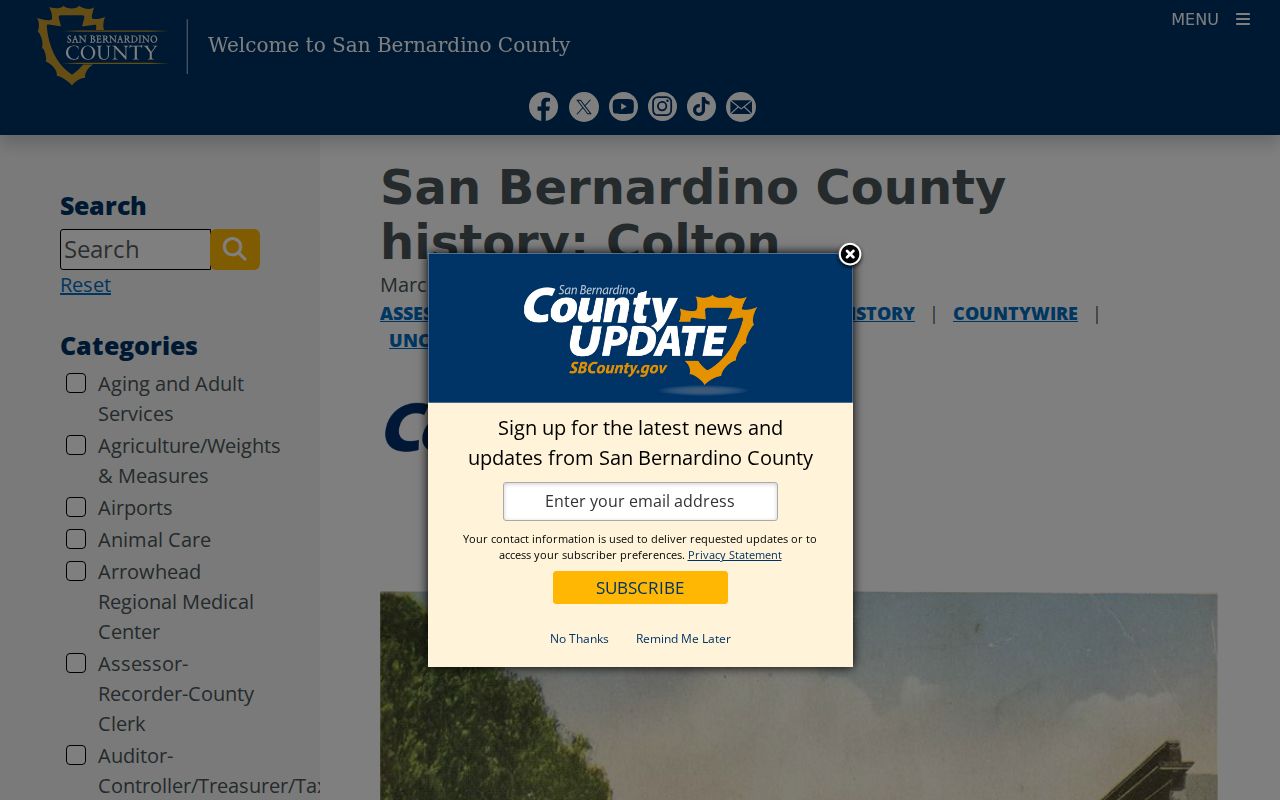
The history adds context about ranchos, citrus, railroads, and the “Hub City” name. Use that context to frame a directory entry, not to fill an absent name.
The 1942 Colton Listing
One of the clearest catalog records is the 1942 San Bernardino Directory Co. city directory, titled as including Colton and Rialto. It is listed in the FamilySearch catalog with microfilm 1320664, item 3, and DGS 7968292. That description matters because the cover title may say San Bernardino while the internal pages carry Colton entries.
Use a catalog record as a path to the volume, not as evidence that every page is currently viewable online. When access is available, record the page image or citation, the publication year, the city section, and whether the name appears in the alphabetical or street portion. Compare the result with a nearby year when a move or a spelling change is important.
| Catalog clue | Why it matters |
|---|---|
| Including Colton and Rialto | Confirms that a regional volume can carry Colton entries |
| Film 1320664, item 3 | Identifies a specific microfilm segment |
| DGS 7968292 | Provides a digital catalog reference when the provider exposes it |
| Publisher and year | Lets a later researcher reproduce the search |
Colton Telephone Books
Colton telephone books extend the historical directory trail through several runs at the Library of Congress. The discovered spans are January 1919 to October 1938, October 1939 to October 1944, October 1945 to October 1948, October 1949 to September 1951, September 1952 to September 1953, September 1954 to September 1955, September 1956, and April 1957 to April 1968. These are subscriber sources, so the name belongs to a listed telephone account, not automatically to every person at the address.
White pages can provide a surname, given name or initial, street address, exchange, and telephone number. Yellow pages group businesses by category and can place a firm or professional role in Colton. The Library of Congress collections gateway is also useful for related map discovery, while telephone-book access should be checked through the relevant catalog record or library service.
Use a telephone book to bridge a gap between city directory years. Preserve the exact spelling and exchange. A disconnected number, an omitted subscriber, or a business listing under a company name is not proof that a household left the city.
Reading a Colton Entry
A typical early twentieth-century Colton city directory entry is compact. It may begin with a surname and given name or initial, place a spouse in parentheses, mark a widow with “wid,” give an occupation or employer, use “r” for residence, and then supply a home address. A business entry can add a workplace address. Some volumes include a homeowner mark, but the mark and abbreviation key must be read in that volume rather than assumed.
A street or householder section reverses the search. It may list the street and number first, then the occupant or business. Telephone pages have their own grammar. This sample inventory keeps the source role clear:
- Alphabetical name, given name, initial, or spouse notation
- Occupation, employer, business name, or workplace address
- Residence marker and home street address
- Street, block, or householder index entry when the volume has one
- Telephone exchange and subscriber number in a telephone book
- Criss-cross directory
- A reverse directory that starts with street and number, then names the listed occupant or business.
- Householder index
- An address-organized section that helps search from a property rather than a surname.
- Abbreviation key
- The volume's own explanation of marks such as “r” or “wid.”
- Listed occupant
- A person named by the publication, not a guarantee that every household member appears.
Reverse Pages by Street
When a Colton city directory has a street section, search the address before searching the surname. Start with the street spelling used in the volume, browse the numbers in order, and capture the occupant, business, and any owner or renter mark exactly as printed. A missing street section does not mean the volume is useless. The alphabetical pages can still connect a person to an address, and the next year may use a different layout.
Modern address work belongs with the parcel map and recorder, while the historical shelf owns the directory grammar. The Colton street directory handles current address-keyed records and explains why the APN is the durable bridge. Keep the historical citation separate from the modern parcel result.
| Search order | What to capture | Common caution |
|---|---|---|
| Street and number | Occupant, business, and printed mark | Numbering may differ across years |
| Alphabetical surname | Name, spouse, occupation, address | Initials and maiden names vary |
| Next or prior volume | Same address, changed name, new role | Omission is not proof of a move |
Trace Colton Households
A household trace works best when directory years are paired with census years. Census schedules are ten-year snapshots through 1950, while directories are annual or near-annual when a publisher issued them. The two sources ask different questions. A census may enumerate household relationships and nearby households. A directory may add occupation, business, phone, or a street index.
- Start with a known household in the 1900, 1910, 1920, 1930, 1940, or 1950 census.
- Check directory years on both sides of the census date and copy names, spouses, occupations, and addresses exactly.
- Use a street section or nearby cross streets to test whether the address stayed in the same block.
- Compare a deed, permit, obituary, or probate entry when a change needs a second date.
- Write down an omission as an unknown, because death, military service, a spouse listing, or publisher coverage can explain a gap.
Pairing years guards against a false smooth story. A family can appear under an initial in one year, under a spouse in the next, and under a business name after that.
Great Registers Before Directories
The California Room's Great Registers from 1880 to 1886 reach into an earlier layer of Colton-area history than the modern web index. Depending on the volume and year, a Great Register can provide a voter's name, age or birthplace, occupation, and local residence. It is a historical registration source under the rules of its time, not a current residents directory and not a complete list of people in the city.
Colton incorporated in 1887, so early records may use county, township, ranch, railroad, or nearby settlement language. Search the county and regional context rather than expecting a modern city heading. The same spelling, occupation, and residence clues can then be tested against a directory, church register, newspaper, or later census page.
The California Room also directs patrons to San Bernardino Sun microfilm and California State Library interlibrary loan guidance. Newspapers can add obituaries, legal notices, and community events that explain why a directory entry appears or disappears.
When Colton Names Disappear
An absent name in a Colton city directory is a question, not an answer. The person may have died, moved, served in the military, been listed under a spouse, used initials, appeared under a business, or fallen outside that publisher's coverage. A street number may also have changed. Compare at least one earlier and one later year before concluding that an address lost a household.
For a person who needs modern verification, a court docket, property record, business filing, professional license, or vital record may supply an independent date or role. The Colton resident lookup keeps those modern sources in a one-person workflow. A directory entry remains valuable because it preserves a historical snapshot that many current systems do not.
No official Colton library obituary index, licensed genealogy subscription, or complete reverse-directory shelf run was verified. Ask the holding library or catalog provider rather than treating a search failure as a gap in the historical record.